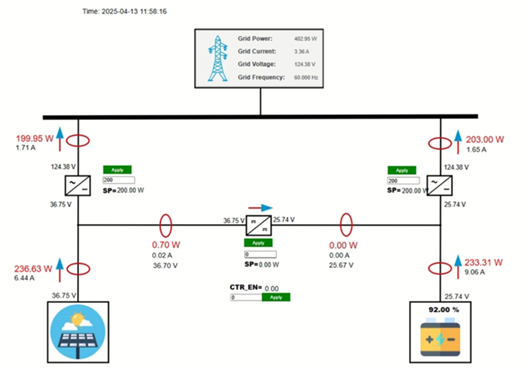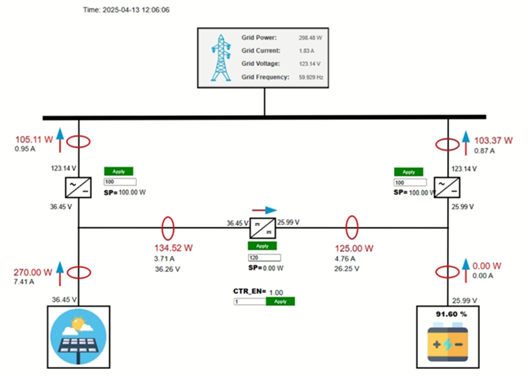
Small-Scale with Utility-Scale Purpose
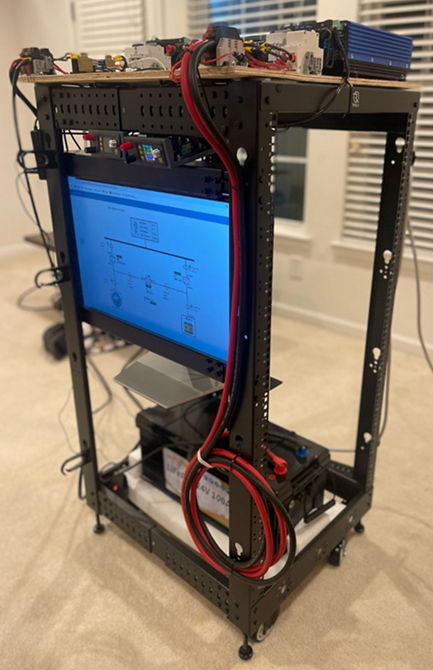
Despite being constructed with 1kW inverters and a 24V battery, the testbed is meticulously designed to replicate the architecture and control behavior typical of utility-scale renewable power plants. In this scaled-down configuration:
-
The solar inverter functions as a model for a grid-tied PV inverter in a commercial solar field.
-
The battery inverter emulates a grid-connected Battery Energy Storage System (BESS).
-
The DC-DC converters are crucial for modeling bi-directional DC transfer, a common feature in integrated hybrid systems.
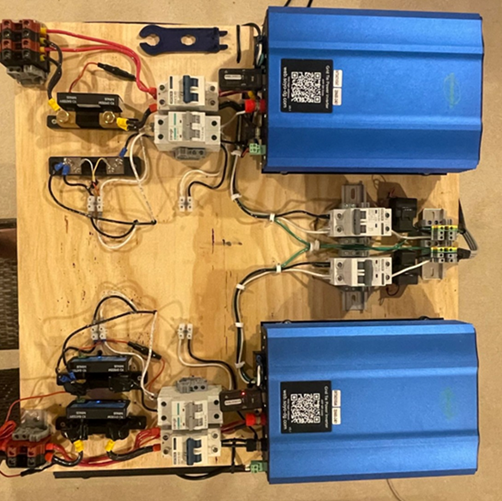
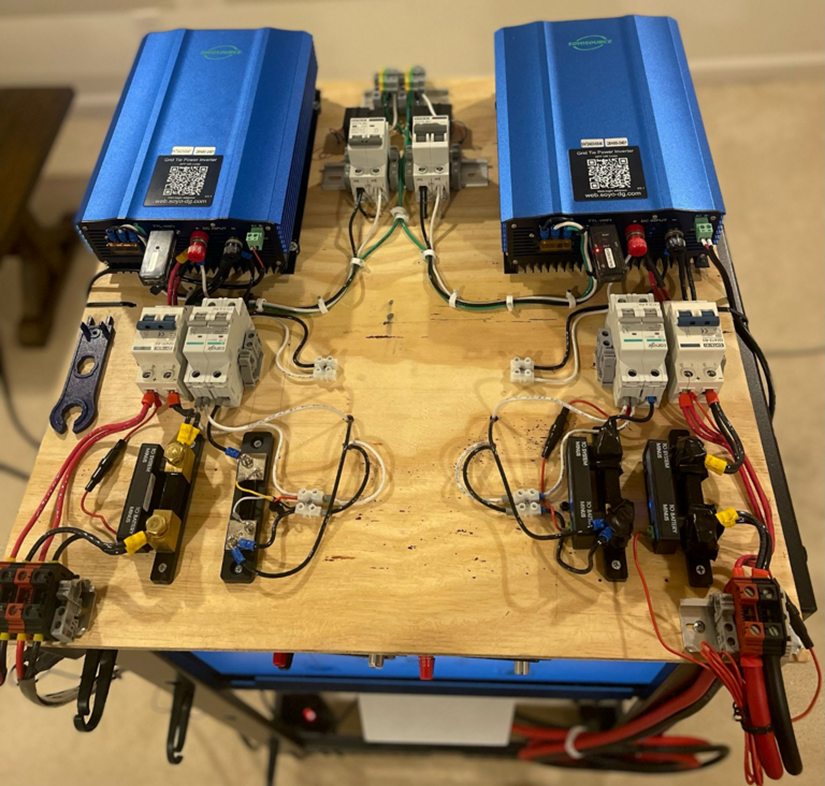
(Refer to the figures for a visual overview of the system components and operational insights.)
System Components
The testbed integrates a comprehensive set of components designed to replicate the architecture and control behavior of utility-scale renewable power plants.
Inverters & Converters
The core of the power conversion system, designed for maximum flexibility.
- Inverters: 2 Soyu 1000W Inverters (Solar & Battery)
- DC-DC Converters: 2 Unidirectional DC-DC Converters (DPH-505)
Energy Storage & Control
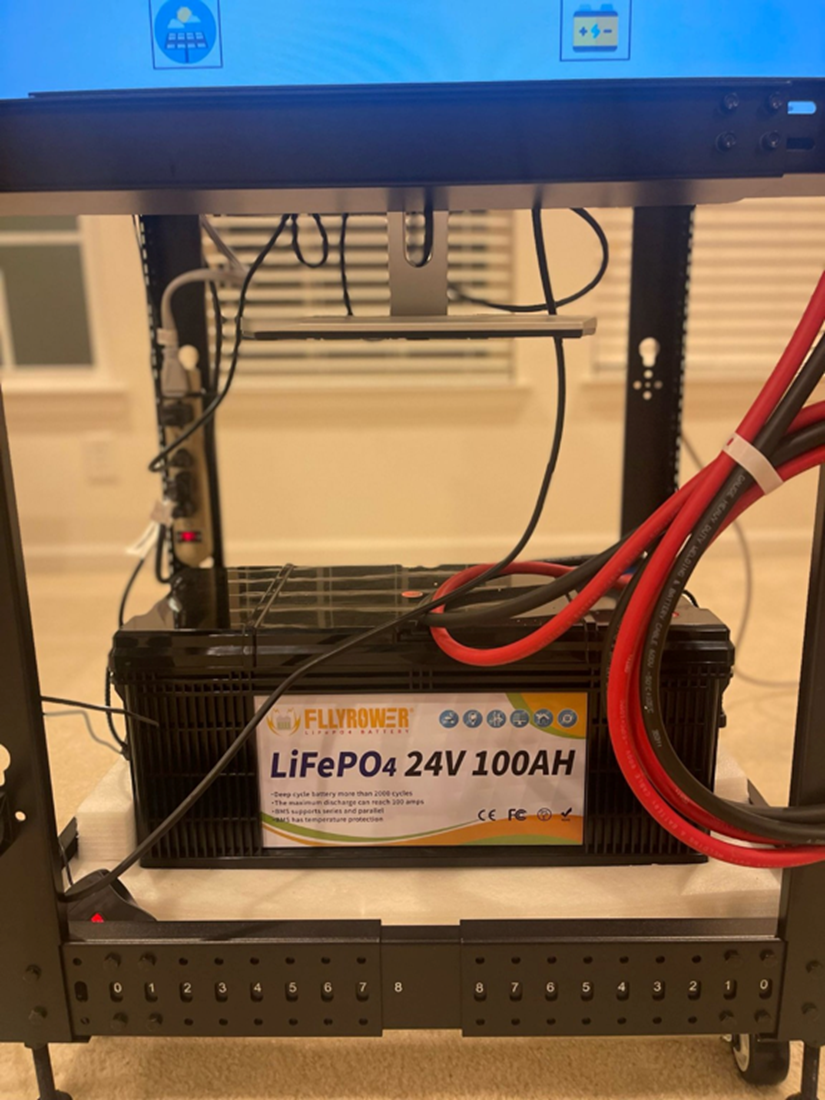
High-performance battery and the central brain of the operation.
- Battery: 1 LiFePO4 Battery 24V 100Ah
- Sensors: PZEM-016, PZEM-017, and Victron SmartShunt
- Circuit Breakers: For protection and control
- SCADA Server: With Python control, Node-RED dashboard, and InfluxDB.
Operational Insights
The provided SCADA screenshots offer valuable insights into the dynamic power flows and control capabilities of the testbed under different operational scenarios.